A real moment is usually unfinished.
Practice ends. Something felt sharp for a few minutes, then ordinary. You were distracted. You slept badly. Or perhaps the session simply felt easier than expected. None of those observations arrives with a clean explanation attached.
The useful first move is not to score the day. It is to keep enough of the moment that you can meet it again later, in context.
The record should be able to survive a better interpretation.
The risk is not too little data. It is a conclusion that arrives too early.
Language models are very good at producing coherent continuations. Coherence can feel like understanding even when the underlying evidence is incomplete. OpenAI's work on why models hallucinate is a useful reminder that evaluation systems can reward guessing instead of honest uncertainty.
Personal context makes the boundary more important. Anthropic's study of how people ask for personal guidance notes that a model often sees a one-sided and incomplete account. That work is not an athlete study, and it does not validate Motus. It supports a more modest design response: ask, reflect, and keep the evidence visible before making a durable claim.
Five principles in the product.
- 01
Record before interpretation
The entry from the moment is the durable object. Any summary, theme, or model-made observation is downstream of it and can be replaced without rewriting the past.
- 02
Show the source
A long-term observation should carry a path back to the days and words that informed it. A plausible explanation is not the same thing as evidence.
- 03
Leave room for not knowing
A single difficult day does not establish a pattern. When the record is thin or contradictory, Motus should say less—not complete the story on the user's behalf.
- 04
Let the person correct the model
People change; context changes; models can be wrong. Any durable description should remain inspectable, rejectable, and revisable by the person it describes.
- 05
Keep consequential decisions with people
Motus supports reflection. It does not diagnose, prescribe training, predict injury, or clear an athlete to return. Those decisions belong with the athlete and qualified professionals.
Each surface has a different responsibility.
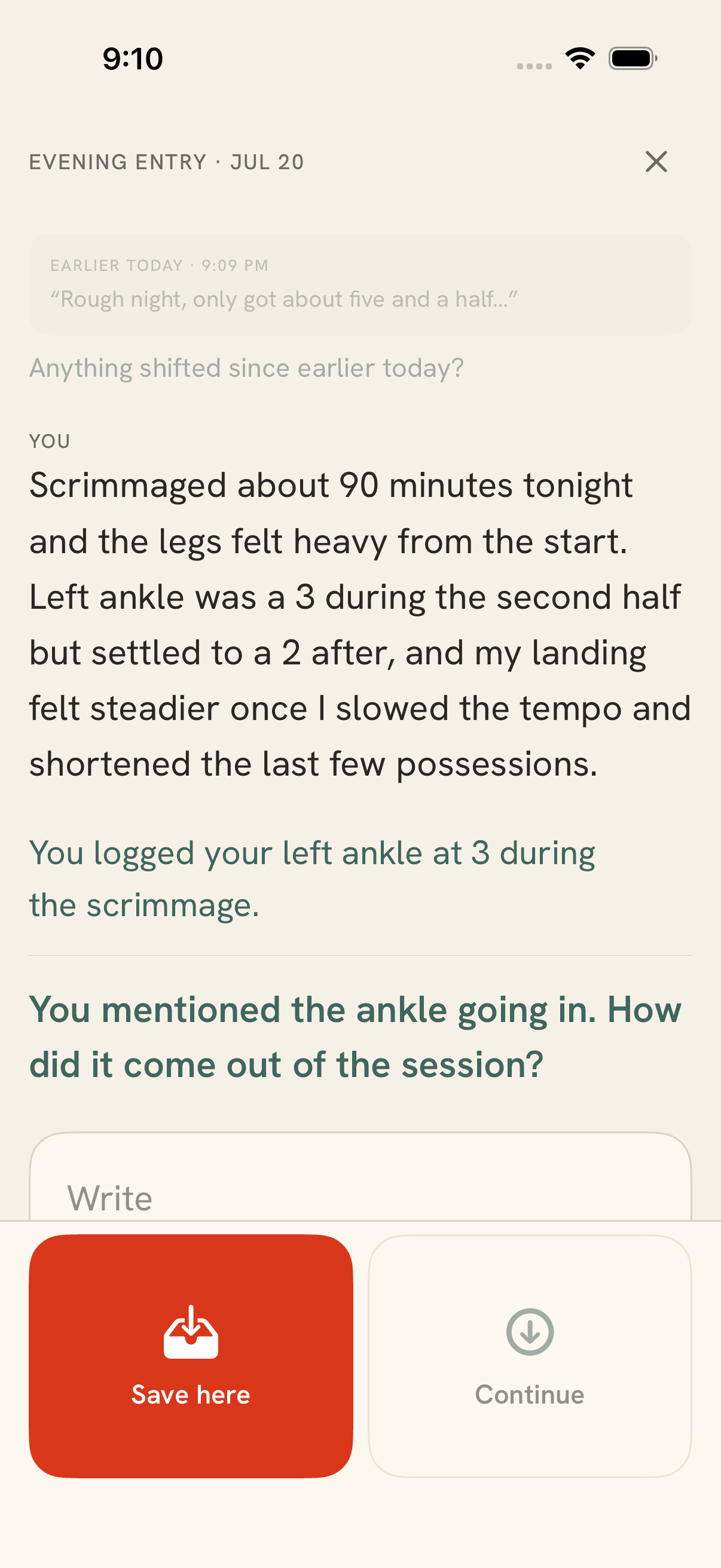
Journal stays close to the present.
The visible conversation makes room for the athlete's words, offers an empathic reflection, and asks one useful question. Deeper analysis belongs outside the visible dialogue and should never masquerade as something the athlete said.
Calendar preserves time without demanding consistency.
A day can be revisited. Weeks and months can make repetition easier to notice. There is no streak to protect and no penalty for silence.
Myself is designed to hold provisional understanding.
When enough records support an observation, it can appear with its source trail. If the evidence changes, the observation can change too. The point is not to build an immutable profile; it is to make self-understanding inspectable.
What Motus does not claim.
Motus is not a doctor, coach, injury-screening system, training prescription, performance predictor, or return-to-play authority. A record may help someone describe their experience more clearly. It does not turn subjective entries into clinical truth.
This boundary also changes how we will evaluate the beta. The question is not whether an AI answer sounds persuasive. The beta will evaluate whether people can record with less burden, recognize themselves in a reflection, return to the source, and correct what the system gets wrong.
Research notes.
These primary sources informed our caution around certainty, memory, and explanation. They are design inputs—not endorsements, partnerships, or proof that Motus works.
Why language models hallucinate ↗
What it supports: A fluent answer can still be wrong; systems should not reward confident guessing when uncertainty is the honest state.
What it does not prove: This is language-model research, not clinical validation of Motus or of athlete journaling.
Dreaming: Better memory for a more helpful ChatGPT ↗
What it supports: Long-term AI memory can become stale or wrong, which makes inspection, updating, and correction important.
What it does not prove: Motus does not claim to reproduce ChatGPT's memory architecture.
Reasoning models don't always say what they think ↗
What it supports: A polished model explanation is not automatically an audit trail; observable sources matter.
What it does not prove: The findings come from specific models and tasks and do not mean that every generated explanation is false.
How people ask Claude for personal guidance ↗
What it supports: Personal guidance often begins with incomplete, one-sided context, so confident judgment and over-agreement deserve caution.
What it does not prove: This is not an athlete study and does not validate health or performance outcomes.